


Page to Screen: Frankenstein (1818/2025)
When I read Mary Shelley's Frankenstein for the first time as a young teenager, I realized how greatly my expectations for the novel had been shaped and manipulated by the cultural absorption and subsequent mishandling of Shelley's work. The monster can speak eloquently? There's no bolt of lightening that jolts him to life? Where is the Bride? When does Dr. Frankenstein say "It's alive!!!!" (never, unfortunately). That familiar image of a green-toned, lumbering drone built by an unfeeling mad scientist was nothing more that a story lost in translation by two hundred years of adaptation. Upon rereading the book just this year I was similarly puzzled by the choice of cover art by Paper Mill Press, which features a hand bursting forth from the ground, more evocative of The Night of the Living Dead than The Modern Prometheus. It is no wonder that Guillermo Del Toro, whose entire career has been so informed and influence by this work, felt obliged and entitled to put his own spin on this much adapted story and stray as far as he wished from the source material.

The only problem is that Del Toro loves Frankenstein too much. Or, rather, he loves Frankenstein's Monster too much. For those who decided to read Frankenstein after watching his film, I can imagine that their first reaction would have been one of similar confusion to my own. While they may expect a narrative that clearly and comfortably casts Victor Frankenstein as an inhumane sociopath and the Creature as a helpless victim, Shelley refuses to allow her reader such a clear distinction. Del Toro, on the other hand, re-emphasizes a dichotomy that was never meant to be there, satisfying the mainstream crowd who can reassure themselves of their own supposed understanding of the story by mindlessly echoing the tired maxim "You know, Frankenstein is the real monster".
I did not, for the record, see the new Frankenstein in a theatre, as such opportunities were limited. Visually, I can hardly fault the film for its creative set design and truly stunning costumes, though some of this spectacle is diminished by its lacklustre cinematography and breakneck editing that results in scenes of narrative insignificance. While the visual details would have been all the more striking on the big screen, I can imagine that this setting would have been disorienting to the viewer. This is a film made for the streaming age, with over-explanatory dialogue, simplistic characterization, and an editing style suited for those watching a film while completing household chores or scrolling on another device. The story, therefor, must be easily digestible, with little nuance or contradiction that may require too much focus or elicit moral confusion from the audience. The result? William Frankenstein, moments before death, saying to his older brother, "You are the monster", or Elizabeth looking wistfully at a caged butterfly as she describes its "fascinating lack of choice", or Victor drinking from bottles of milk to emphasize his oedipal obsession with his deceased mother.

The same can be said in the casting of certified heartthrob and all around golden boy Jacob Elordi as the Creature. While his 6'5" frame makes practical sense, and his performance may be worthy of its positive critical reputation, his casting, and the design of the character, so clearly encapsulates the film's greatest misstep: the Monster is not ugly, and Del Toro knows it. His body is perfect proportioned and toned, Elordi's face hardly disguised under hours of makeup and prosthetics. He looks, and on occasion behaves, as if pulled out of a superhero film, at times not knowing his own strength but generally innocent of any wrongdoing. Del Toro is unwilling to engage with the idea that mistreatment could make someone genuinely cruel. Coincidentally, this same reinterpretation befalls Elordi's portrayal of a neutered Heathcliff in Emerald Fennell's "Wuthering Heights", but that's a conversation for another time. This Creature is familiar, never demanding that the audience consider their own relationship with the grotesque and uncanny.
"His yellow skin scarcely covered the work of muscles and arteries beneath; his hair was of a lustrous black, and flowing; his teeth of a pearly whiteness; but these luxuriances only formed a more horrid contrast with his watery eyes, that seemed almost of the same colour as the dun-white sockets in which they were set, his shrivelled complexion and straight black lips."
(Description of the Creature by Shelley)
Ultimately, the defanging of one character comes at the expense of vilifying another, as Victor Frankenstein undergoes an unfortunate reinterpretation that ultimately divorces the film from the central themes that make the novel so powerful. Prior to revisiting the novel, having not engaged with it closely for several years, I was under the impression that the "Frankenstein is the real monster" adage was an astute and accurate interpretation. I have since been convinced otherwise. Del Toro nevertheless presents a classic villain origin story, in which our protagonist is relentless tormented by his father, thus creating a clear through-line to Victor's own abusive treatment of his "son" that the audience can easily follow. In fact, Shelley gives Victor a happy childhood and adoring parents who love one another. Elizabeth, in the film the vacant fiancée of Victor's brother, is in the novel Victor's adopted sister, whom he comes to view almost one might view a prized horse, "since till death she was to be mine only". I can imagine Netflix executives bristling against this suggestion of quasi-incest and vying for a more palatable option for easily offended audiences.

As in the book, Victor's obsession with preventing death comes after that of his beloved mother. This plot point, I assume as an armchair researcher, was greatly inspired by two major events in Shelley's life: the death of her mother Mary Wollstonecraft, who died as a result of complications after her daughter's birth, and the death of Shelley's own premature baby daughter. Having been on both sides of coin, as both a daughter and parent, I suspect Shelley would have had the ability to regard and portray both of her leading characters with empathy. She is both Victor Frankenstein and the Creature, a creator of life and one who suffers because of it. Much of Victor's psyche, from the moment his creation breathes life till he breathes his last, brims with intense regret, paranoia, and anxiety, such that the modern reader might recognize as akin to postpartum depression.
"The appearance of death was distant, although the wish was ever present to my thoughts; and I often sat for hours motionless and speechless, wishing for some mighty revolution that might bury me and my destroyer in its ruins."
As a reader, I felt my sympathies torn between both imperfect beings, as I believe Shelley intended. She bestows the Creature with a heart and mind vulnerable to cruelty. She condemns Frankenstein's actions, but never condones his suffering.
Del Toro, ironically, seems incapable of imbuing Victor with the humanity he deserves. This failed characterization manifests most clearly in the climactic scene between Victor, the Creature, and Elizabeth. In this version of the story, Elizabeth has fallen in love with the Creature, possible thanks to his aforementioned aesthetic redesign. Her death is not at the vengeful hands of the Creature, as in the novel, but of Victor's, who accidentally shoots her in attempt to finally destroy his creation. This narrative change removes a critical element of the novel that cements it as a great work of horror: Victor's utter lack of control from the moment he abandons his creation. In the novel, the Creature kills many innocents, and indirectly leads to the deaths of others. All these deaths stem from Victor himself, but crucially, he is not present for any of them. That is what makes Frankenstein such an enduring work of horror, and why Del Toro, by placing the gun in Victor's hand, ultimately fails to convey the dread of seeing one's entire world collapsing in front of them while being helpless to stop it.
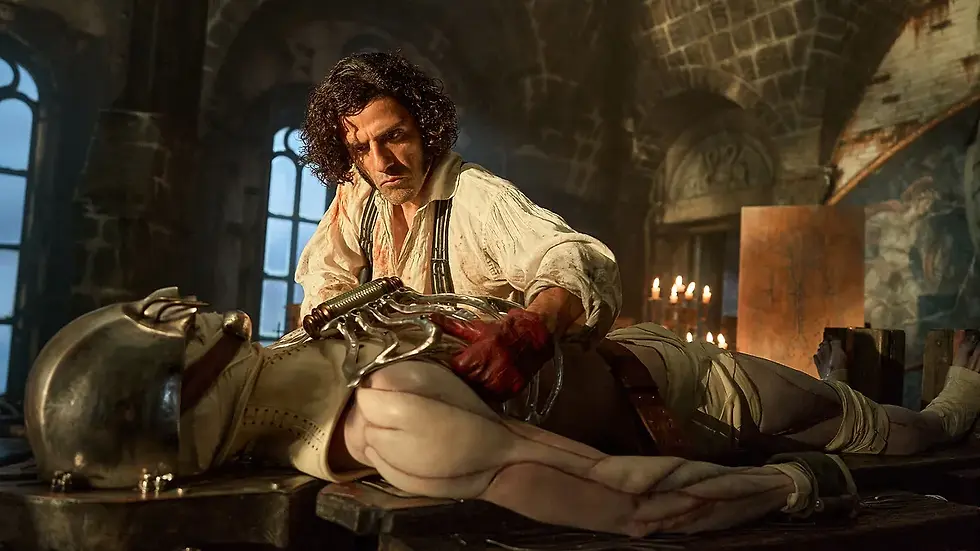
Frankenstein has undergone copious reinterpretations and re-imaginings over two hundred years, with varying degrees of adherence to the source material. While I certainly don't believe that this and every adaption that is sure to follow must be unwavering loyal to the original text, I do think that a work that strays too far is at risk of missing the point of the story. It is a story about parenting and being parented, about existential dread, the relationship between God and Man, the socially outcast, and the experience of womanhood. But my pet theory is that I believe Shelley was greatly informed by her role as an author and an artist, and those who surrounded her. Artists like her husband Percy Bysshe Shelley, friends Lord Byron, Keats, Coleridge, Polidori, had the shared experience of creating art and releasing it into the world. Such an act of vulnerability naturally inspires feelings of anxiety and insecurity, not unlike that of a parent watching their child leave the house for the first time. Given the period's neoclassical inclination, and Shelley's level of education, we can assume her familiarity with the the oft recited and misunderstood Socratic anecdote in which the philosopher characterizes the written word (in comparison to spoken rhetoric) as unable to fully represent an artist's intention:
"it is like a picture, which can give no answer to a question, and has only a deceitful likeness of a living creature . . . It is not a legitimate son of knowledge, but a bastard, and when an attack is made upon this bastard neither parent nor anyone else is there to defend it."
Plato, Phaedrus
Shelley, who died in 1851, could never have anticipated how her work would be pulled and twisted into different directions over the centuries, how it would inform entire genres of storytelling and inspire literally thousands of works across mediums that didn't even exist in her lifetime. Among the countless artists and imaginaries her work touched is, of course, Guillermo Del Toro, whose entire filmography has arguably been the result of his personal identification with Frankenstein's Monster. The result is a film that actively avoids themes and ideas that require deeper consideration or self-reflection, indicative of a culture and audience growing increasingly unwilling to engage with classical literature or media that hasn't been rendered acceptable to modern sensibilities, one that insists upon clarity, explanation, and comfort.


Comments